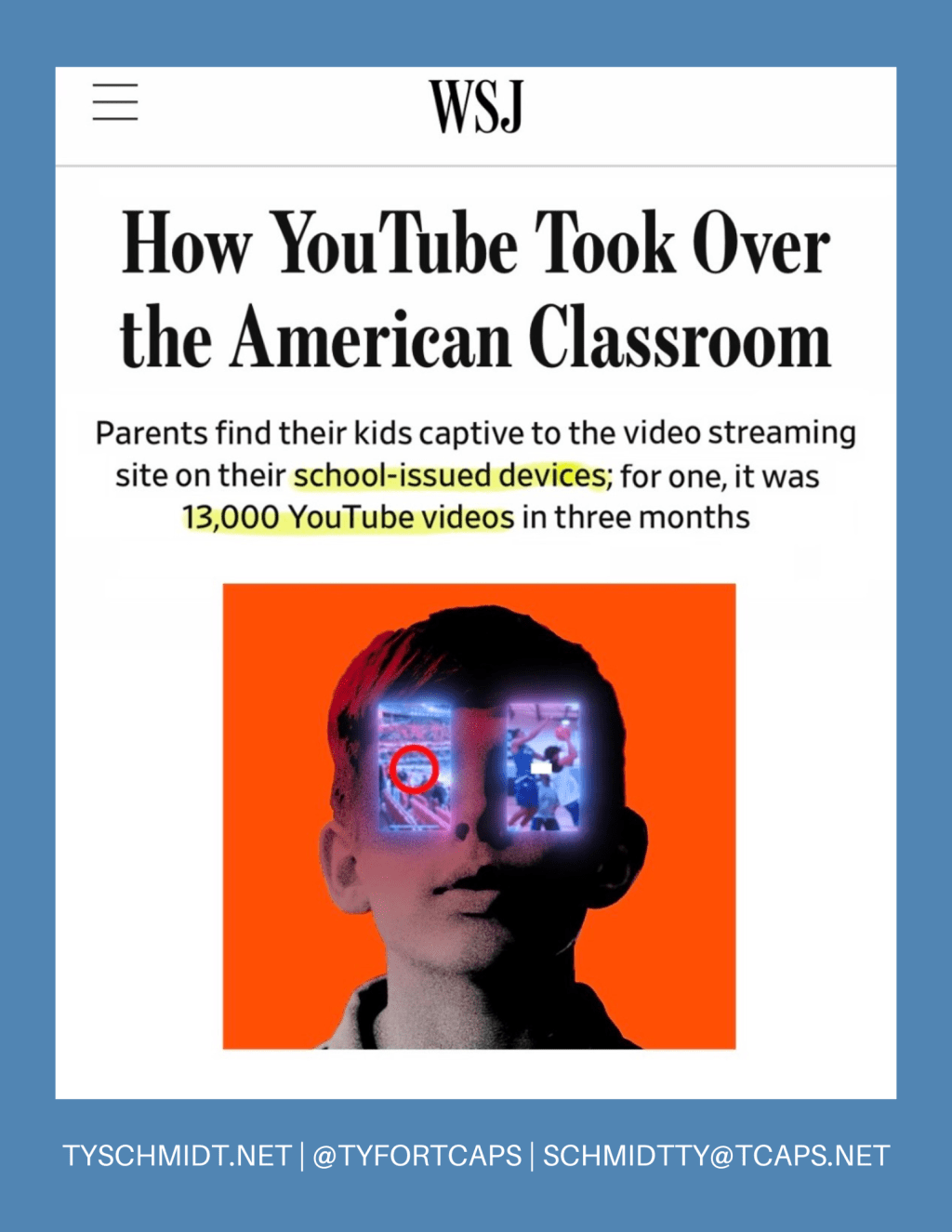
It’s hard to read stories like this one from Thursday’s Wall Street Journal and not feel a mix of concern – and responsibility.
A recent report on the role of YouTube in schools highlights something many families and educators are noticing: students spending large parts of the school day on screens – sometimes learning, and sometimes not.
What matters is how we use tools like Chromebooks and YouTube.
• Are devices helping students build strong reading and math skills?
• Are they supporting focus, curiosity, and deep thinking?
• Or are they making it easier to drift, distract, and disengage?
These aren’t questions about blame.
These are questions about priorities and systems.
As a school board member, my focus is on policy, budget alignment, and our 2030 Goals**:
• Success for every one of our kids
• Strong foundations in literacy and math
• Strong schools where students can grow and flourish
Technology should support those goals – not compete with them.
That means asking some hard, but necessary questions:
• How is our continued investment in 1:1 Chromebooks in elementary and middle school impacting student outcomes?
• Do we have the right policy guardrails in place to minimize distraction and maximize learning?
• And how do we ensure all students, especially those furthest from opportunity, get the focused learning time they need?
We owe it to our students and families to ensure that every tool we use, digital or not, moves us closer to our vision** – “an educational community providing opportunities and resources to relentlessly support all learners in achieving their full potential.”
 I’m interested in hearing from families and educators:
What are you seeing?
What’s working?
What’s not?
 Read the full WSJ story: https://bit.ly/4cPlkUM
* A snapshot of our most recent math/reading outcomes: https://bit.ly/4rfmNaV
** Our vision, mission, values, and new five-year strategic plan goals: https://bit.ly/tcaps-values


Leave a Reply