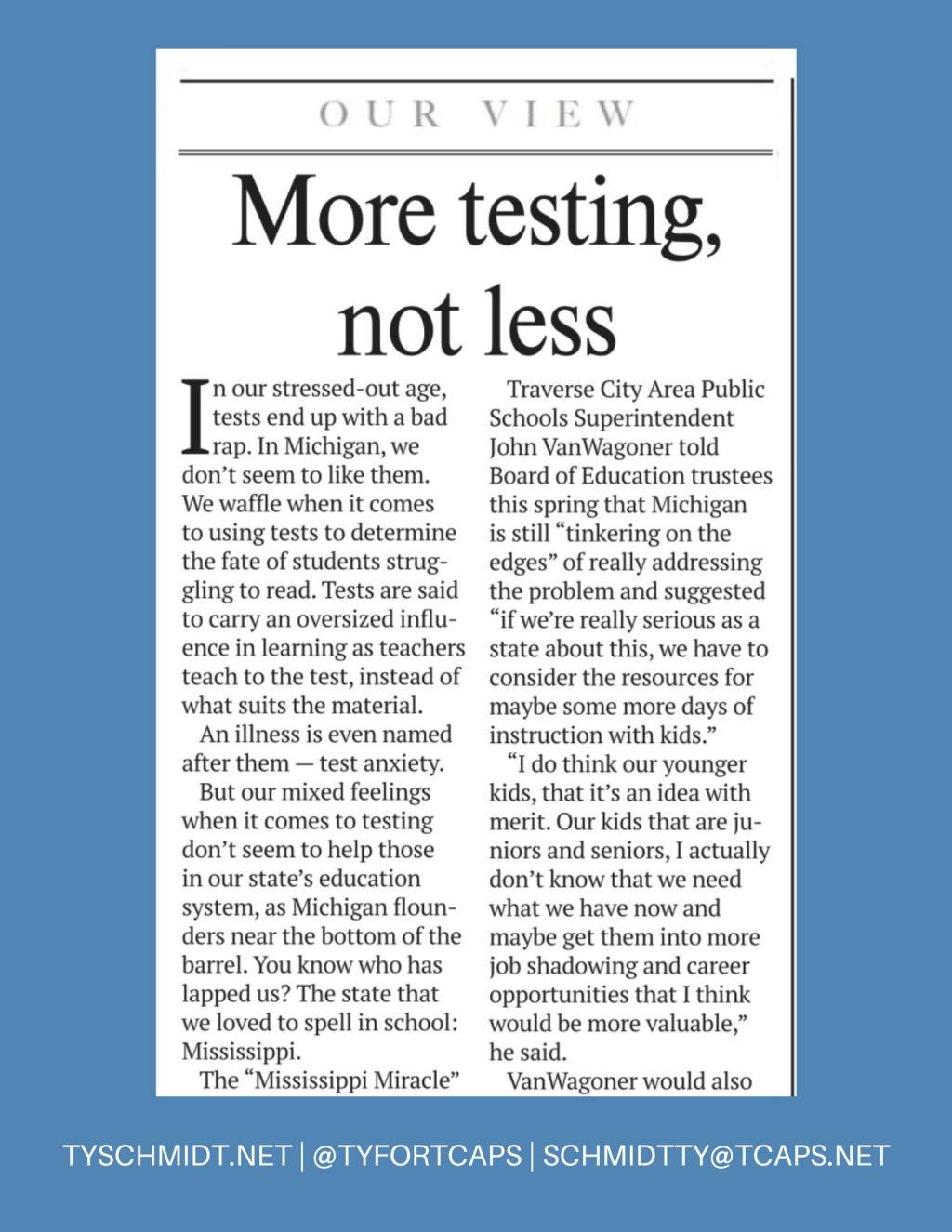
I appreciate the Traverse City Record-Eagle‘s willingness to put education and Michigan’s literacy challenges in the spotlight in today’s paper.*
It’s an important conversation, and one I think all of us – educators, parents, school board members, legislators and community members – need to be willing to have honestly.
Michigan’s literacy outcomes are not where they need to be.
And that’s true here in Traverse City, too.
In fact, our most recent state assessment (2025 M-STEP)** shows that, for the first time in TCAPS history, more of our third-graders were not proficient in reading than were proficient – 51% to 49% (our 2026 state assessment outcomes will be made public next month).
That’s a sobering fact.
It should get our attention.
The editorial also highlights Mississippi’s remarkable progress in literacy, and I couldn’t agree more that there is much Michigan can learn from what happened there.
I’ve written about the Mississippi literacy story before,*** and one lesson that stands out to me is that meaningful improvement didn’t happen overnight.
It took sustained attention, consistent policy, resources, instructional changes and, perhaps most importantly, a willingness to look honestly at the outcomes and respond.
The editorial also highlights something our superintendent has said to our board: that our current state assessment cadence – one M-STEP a year, with results arriving months later – functions more like an autopsy than a tool teachers can act on.
I think he’s right to push that conversation in Lansing, where any change to the M-STEP’s frequency would ultimately need to happen.
But while that conversation plays out, I want to make sure our community knows what’s already happening here locally, with tools already in our hands.
Our elementary teachers use NWEA and AimswebPlus throughout the year to see, in close to real time, who’s learning, who isn’t yet, where the gaps are and what needs to change – well before an M-STEP score would reach them.
AimswebPlus, administered three times a year to every K–5 student, is designed for this kind of early identification.
And the NWEA provides another source of information teachers can use to understand student growth and identify areas where additional support may be needed.
That’s the kind of timely, actionable information the editorial is asking for.
And it’s information we already generate and use, right now, independent of any change in state policy.
That’s one reason I’m encouraged by the work happening here through our new 2030 Vision****.
We’ve established measurable five-year goals for literacy and math.
We’re reporting our progress publicly*****.
And we’re investing in strategies****** designed to improve instruction and provide additional support where students need it:
• strengthening literacy intervention
• instructional coaching
• curriculum and assessment alignment
• targeted support for students who need additional help
None of this means we should simply give students more tests.
It means using the assessments we already have well, consistently, and for the right purposes, alongside the broader policy conversation happening at the state level.
The Record-Eagle is right to shine a light on Michigan’s literacy outcomes.
We should also shine that light on what we’re doing about them, at every level – state and local alike.
There is no single assessment, program, or policy that will solve this.
But there are lessons we can learn from Mississippi, from other states, from other districts and from our own classrooms.
And there is no shame in acknowledging where we’re struggling.
The only way we’re going to move the needle is to be honest about where we are, measure whether we’re making progress, learn from what works, and stay committed to doing better for our kids.
*Read today’s Record-Eagle editorial: https://bit.ly/4wH6PJ0
**Our most recent third-grade reading state assessment outcomes (M-STEP): https://bit.ly/4rfmNaV
***My previous “Mississippi’s Reading Miracle: A Lesson for Michigan?”: https://bit.ly/4c6uDie
****Our new five-year strategic plan goals: https://bit.ly/tcaps-values
*****Strategies we’re investing in this year to improve literacy outcomes: https://bit.ly/4dd3cmv
******This year’s NWEA elementary reading and math outcomes: https://bit.ly/4xbOgxe
*******Our current district assessment schedule, including MSTEP, NWEA, AimswebPlus, PSAT, SAT, MI-Access, WIDA (starts on page 11): https://bit.ly/3UDaZRQ


Leave a Reply